Free tours in Marrakech
Offering you 111 tours in Marrakech, Morocco




50,179 Reviews in Marrakech
What is a free tour, and how does it work?
The concept of free tours is that you do not pay a fixed price per visit per person. Moreover, at the end of the tour, if you liked everything, you can leave a tip to the guide.
How long do the free tours in Marrakech typically last?
Tours in Marrakech usually last about two hours. During this time you will have time to get around the most important attractions of the city.
Are the tours available in languages other than English, such as Spanish?
Yes. Our tours are available in different languages and include Spanish, German, Italian or Portuguese.
Is there a set price for the free tours, or do I pay what I think is fair?
You have the right to pay as much as you see fit since the price should be based on the experience you have gained. If you liked everything, you can reward the guide.
What can I expect to see and experience on a free tour in Marrakech?
Marrakech tours are designed to show you the city's main attractions while saving you the time you would otherwise spend organizing a similar itinerary.
Discover the Medina Through Stories, Souks, and Landmarks
Marrakech can be described as noise, smell, walls that all look the same, and within ten minutes, you've lost the street you came from. Moreover, the Medina of Marrakesh, which is UNESCO World Heritage-listed historic heart of the city, was built that way on purpose. For some, it seems fascinating, for others — deeply inconvenient. You can book a free walking tour in Marrakech from FREETOUR.com on day one. It turns confusing days into two clear hours on a pay-what-you-wish model and with verified options by language and time.
Why Take a Walking Tour in Marrakech?
Medina looks the same in every direction (and that's not an exaggeration). The walls are all the same height, the same color, and half the alleys dead-end into someone's front door. But here's what guides on free tours in Marrakech change:
- Navigation. It means that you stop second-guessing left or right and start looking at things.
- Story. The gap between the central square and a palace courtyard is about eight minutes on foot, but it's also about six centuries of political history. And a good guide makes that feel like an interesting story.
- Time. Standard routes run 2 hours. You cover more in that window than most people manage in a full solo day.
- Language. Multilingual guides can speak English, Spanish, German, Italian, and Portuguese. Just choose the language on the site when booking a tour.
Marrakech by Senses: How the City Opens Up on Foot
- The Heartbeat of Jemaa el-Fnaa. It is calm in the morning. You can see vendors setting up and a few early tourists. Come back at nine in the evening, and it's unrecognizable. You will see Gnawa musicians playing and feel smoke from the grill stalls. If your walking tour in Marrakech ends here at dusk, it is better to stay a while to feel the atmosphere deeply.
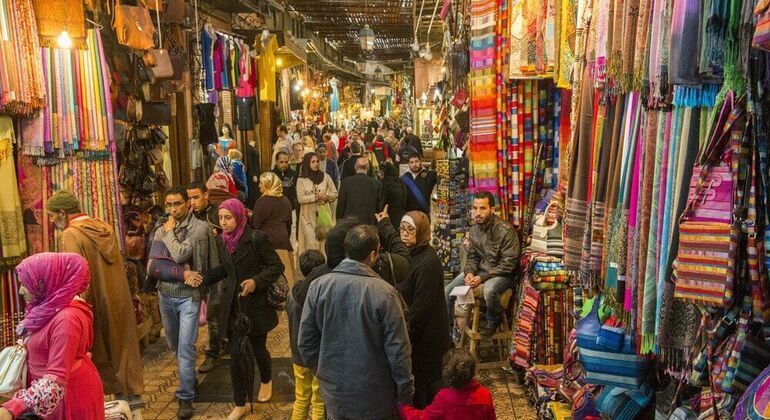
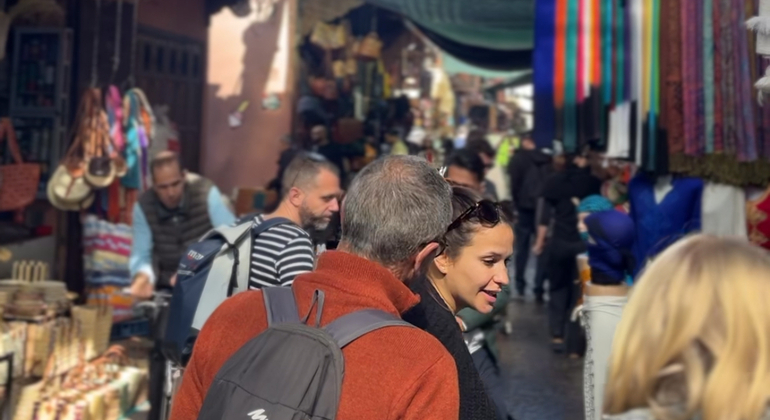
- The Medina Labyrinth. Souk Semmarine is the “main artery”. This market is wide and lined with leather and textiles. Then it fractures into narrower lanes where the artisan quarters get more specific, and the haggling gets more pointed. By the way, your guide knows when a price is fair and when you're being sized up.
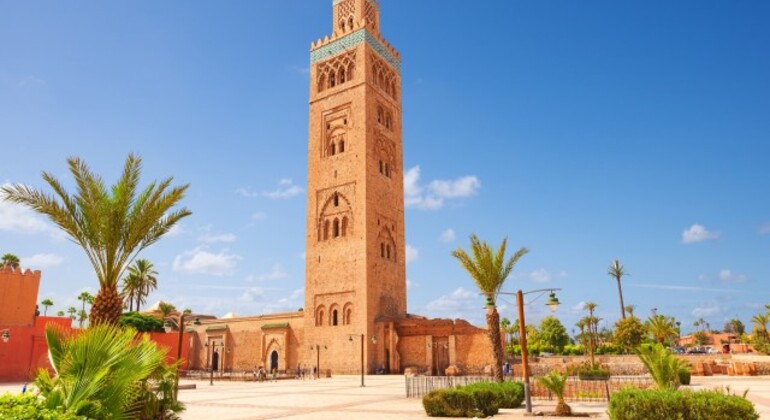
- The Koutoubia Skyline. Keep looking up. The minaret of the Koutoubia Mosque is visible from almost anywhere in the old city, and that's not a coincidence. It was built in the 12th century to orient people and still does.
Architectural Jewels: From Palaces to Historic Madrasas
- Palatial Grandeur. Bahia Palace is almost absurdly ornate. There are cedar ceilings carved to the millimeter and Moorish and Arab-Andalusian zellij tilework on every surface. It was built to impress. It still does, which says something either about the craftsmanship or about how rarely anything since has matched it. El Badi Palace is the opposite end of the same story. What was once called the Incomparable Palace is now largely ruined. Unfortunately, it was stripped of its marble and gold by a later sultan who needed the materials elsewhere. Yet, grandeur that's been deliberately taken apart still reads as grandeur.
- Sacred Spaces. The Saadian Tombs were walled off for three centuries and only rediscovered in 1917. Standing there, it's hard not to wonder what else might still be sealed somewhere beneath the city. The Ben Youssef Madrasa was a working school. There are hundreds of students and extraordinary architecture built specifically for learning, not display.
Choosing Your Route: Which Experience Fits Your Visit?
Three rough types of free walking tours in Marrakech suit different travelers. Knowing which one you want before you book saves time.
- The Classic Orientation. This one is for people who landed yesterday and need the city to make basic geographical sense before anything else. It covers major landmarks and the main routes in and out. Nothing too deep. It is just enough to stop feeling turned around every ten minutes.
- The Cultural Deep-Dive. It is for people who want to understand why the city is shaped the way it is. The Almoravid Dynasty founded it in 1070, what Imperial City status actually meant in practice, and how the Mellah (the old Jewish quarter) ended up where it did, surrounded by palaces on all sides. There's a lot of history squeezed into a small area.
- Atmosphere & Photography. The third type is for photographers and people who respond more to “texture” than timeline. It covers hidden riads, rooftop access, the visual density of the spice markets (saffron in tiny paper twists, great dusty piles of ras el hanout), etc.
Why the Red City is Unlike Any Other Walking Tour
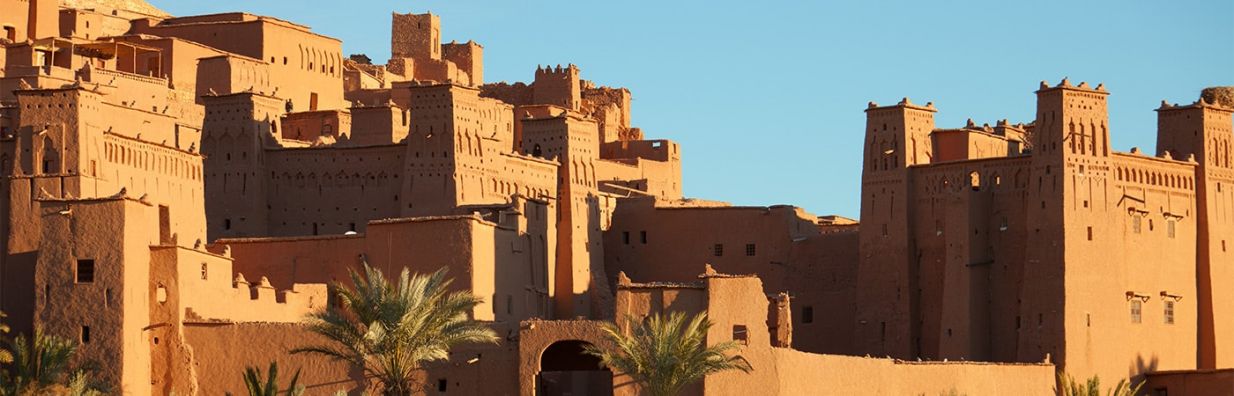
Marrakech is called the Ochre City because of the pinkish clay from which its walls are built. And that color is everywhere. The light takes it on in the late afternoon, and the dust on your shoes after an hour of walking is the same shade. But what makes the city unusual for walking tours is its structure. There's no obvious landmark hierarchy and no central avenue that orients everything else. The beauty here is behind doors that look like nothing, inside Bab Agnaou and beyond, and through thresholds that seem private until they're not. And that was intentional. A city designed so that outsiders couldn't navigate it quickly. It worked for centuries, and it still works now, actually.
Faux guides prey on exactly this disorientation. They offer to help and lead tourists to shops where they collect a cut. It's not dangerous, just annoying and expensive. But booking through FREETOUR.com means you're walking with someone who lives there, not someone who profits from you being lost.
Practical Flow: How Free Tours Work in the Ochre City
- Model. The pay-what-you-wish model is self-explanatory. The tour happens anyway, and you tip what you want at the end (if you want, of course). No minimum and no expectation set in advance. But please, tip in Moroccan Dirham (MAD). Foreign currency means a trip to a currency exchange, fees, and so on.
- Timing. A free tour in Marrakech will take about 2 hours. It gives you enough time to visit the major landmarks.
- Preparedness. Wear shoes you'd walk five miles in, because you might. Dress modestly, covered shoulders and knees, partly out of respect and partly because some sites won't let you in otherwise. Also, bring water and sunscreen, as the sun reflects off the walls.
Best Moments for Exploring: Morning Clarity vs. Evening Energy
- Morning. It is great for exploring architecture. It's much easier to look at things without people in the way. It's also the one window where, on a clear day, the Atlas Mountains are visible from the city. There is snow on the peaks, and the whole scale of the region is suddenly legible in a single glance.
- Late afternoon. There will be more people, more noise, and more life. But the warm light does flatter the walls in a way that makes even ordinary photos look so nice.
- Evening. This is when you can see the El Badi Palace in long shadow at first, then visit the Tanjia Marrakchia at a table with no menu, and then drink mint tea to end the day. Very relaxing.
Why Marrakech is One of the World's Most Immersive Urban Experiences
Most cities are easy to understand. But Marrakech doesn’t work like that. The Medina is a maze that folds back on itself; doors appear where there were only blank walls a minute ago. Walking tours in Marrakech are not there to ruin the mystery. They give you the framework to enjoy the chaos instead of feeling totally lost. It’s the “key” to a very complex city. So, find your guide at FREETOUR.com and start exploring this beautiful place.

- Free Tours in 140+ countries!
- Trusted ratings & reviews!
- Free booking 100% guaranteed!
- FAQs about free tours in